
AI traffic is growing 45% a year, but still equals just over 1 visit for every 100 from Google
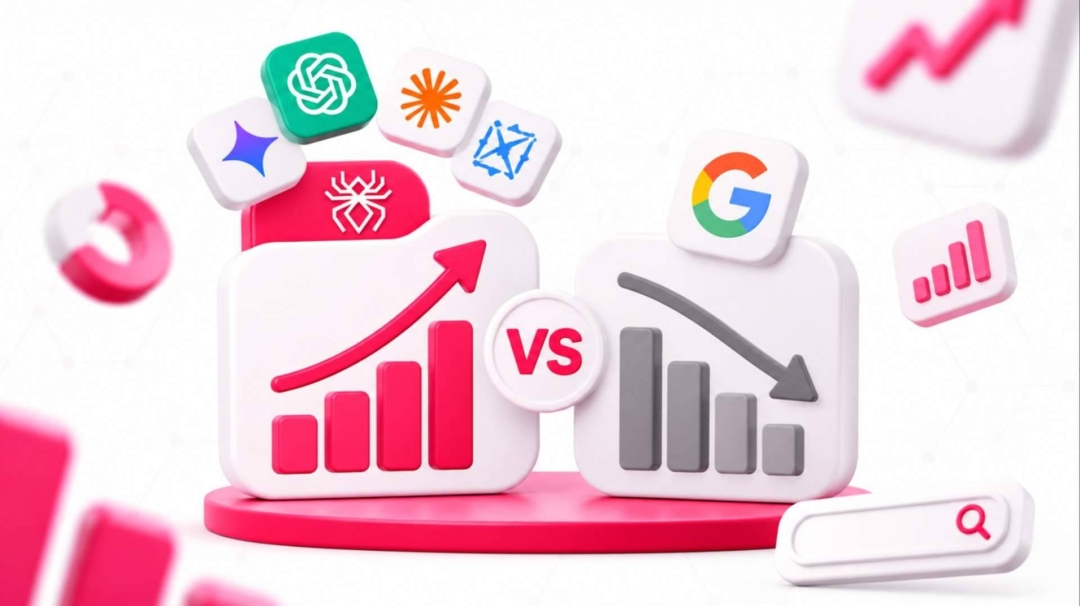
Andorra – November 6, 2026 – SEOcrawl AI analyzed more than 16,000 websites to put numbers on the shift: traffic from AI assistants is surging, yet still amounts to a tiny fraction next to traditional search, which is down 15%.
The traffic that AI assistants send to websites is one of the fastest-growing channels, but it is not moving the needle yet. That is the picture from an analysis by SEOcrawl AI of more than 16,000 websites, which tracked traditional search and the new generative channel side by side over the past two years.
The figure that stands out most is the speed of the AI channel. Sessions that conversational assistants (ChatGPT, Gemini, Perplexity and others) send to websites grew roughly 45% year over year across the more than 3,000 sites with analytics connected, and their share of total traffic rose from 0.24% to 0.36% in a single year.
That growth, though, has to be read in context. Today, for every 100 visits arriving from Google’s organic search, AI contributes 1.25; a year ago it was 0.7, and in the most recent month measured it was already nearing 1.5. It is growing fast, but from a base that is still tiny. The two ratios compare different samples: AI traffic is measured across more than 3,000 sites with analytics connected, and Google’s across the full set of more than 16,000.
And it is doing so while the main channel contracts. Across that same sample of more than 16,000 sites, organic Google clicks fell 15% year over year, with a 20% drop at the median site and declines at 69% of domains. The uncomfortable takeaway: what websites lose in traditional search is not, for now, being recovered through AI.
There is also a significant caveat that cuts in AI’s favor: much of that traffic is not even detected. Visits that arrive from the ChatGPT app usually lose their referrer and end up logged as direct traffic, and clicks from Google’s own AI answers (AI Overviews and AI Mode) are recorded as organic in Search Console, with no way to separate them. In other words, the real AI figures are almost certainly higher than any study can measure today.
The analysis draws on aggregated, anonymized data from more than 16,000 websites in SEOcrawl’s user base that have authorized the aggregated, anonymous analysis of their data, measured between May 2024 and August 2026 (the AI portion, across the 3,000-plus sites with analytics connected, since March 2025). It relies on clicks rather than impressions: in September 2025 Google withdrew the parameter that returned one hundred results per page, and after that change the impressions recorded in Search Console fell for technical reasons unrelated to real demand, so the study is based on clicks, which reflect real visits. To avoid distortion from websites coming and going, it used fixed cohorts of sites.
“The easy headline would be that AI is already eating traffic, and that is not true yet. But keep in mind we are only seeing the tip of the iceberg: part of AI traffic is not even logged as such. What matters is the speed, and at this rate preparing for AI search stops being optional,” says David Kaufmann, CEO and co-founder of SEOcrawl.
The study is published by SEOcrawl AI, the SEO and GEO platform that measures brand visibility and traffic across both search engines and AI assistants in a single dashboard. It combines Google Search Console and Google Analytics 4 data with mention tracking across the major language models, so each user can see how much traffic comes from each source and how it shifts month to month.
Within that AI traffic, the split is highly concentrated: ChatGPT takes 83%, well ahead of Gemini (6%), Perplexity (5%), Claude (4%) and Copilot (2%). For a brand, that means its visibility in the AI channel is decided today almost entirely inside a single product, a concentration with no parallel on the traditional search side.
On what all of this means for brands, the read comes from SEO Alive, the GEO (generative engine optimization) and SEO agency specialized in visibility in AI-driven search, which works with this kind of data every day to get companies to appear and be cited in the answers of ChatGPT, Gemini, Perplexity, Claude, and Google’s AI overviews.
Behind these figures is a deeper shift in how people look for information: more and more searches are resolved inside the answer itself, with no click at all, whether in a chatbot or in Google’s own AI summaries. The agency’s practical reading is clear: do not wait until the channel is big to work on it, but measure first what AI says about each brand and how much traffic it drives, then act.
“At the agency we see it every day with our clients: the mistake is waiting until the AI channel is big to start working on it, because by then the positions will already be taken. The first step is to measure what AI says about your brand; then, to show up where people are starting to ask,” says Jesús Páez Moreno, CEO of SEO Alive.
About SEOcrawl AI
SEOcrawl AI is the SEO and GEO platform from SEOcrawl SL, based in Andorra, measuring brand visibility and traffic across search engines and AI assistants in a single dashboard. It combines Google Search Console and Google Analytics 4 data with mention tracking across the major language models. Learn more at seocrawl.ai.
About SEO Alive
SEO Alive is an international SEO and GEO agency based in Andorra, founded in 2019, that helps brands gain visibility in both traditional organic search and AI answers (ChatGPT, Gemini, Perplexity, Claude and Google’s AI overviews). Learn more at seoalive.com.
Press contact: David Kaufmann, SEOcrawl · [email protected] · seocrawl.ai
Media Contact
Company Name: SEOcrawl AI
Contact Person: Press Office
Email: Send Email
Country: United States
Website: https://seocrawl.ai/


