
MLC Dharmendra Bhardwaj launches a five-pillar youth mental health drive for Meerut
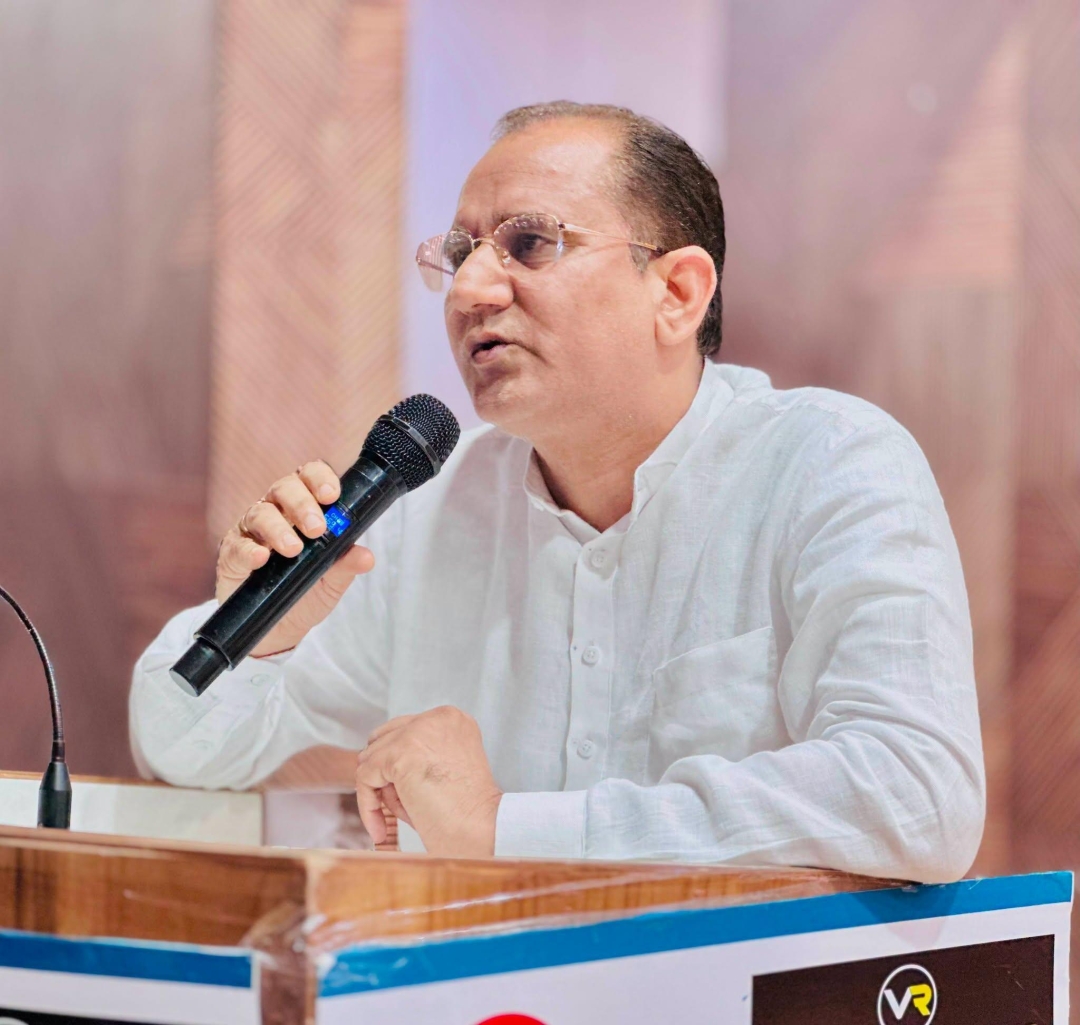
MEERUT, UTTAR PRADESH — Friday, 18 September 2026 — MLC Dharmendra Bhardwaj, Member of the Uttar Pradesh Legislative Council from the Meerut-Ghaziabad Local Authorities constituency, today announced the Meerut Youth Mental Health Initiative — a five-pillar programme designed to address the mental-health crisis among the district’s young people. The Initiative integrates school-and-college counselling cells, coordination with the District Mental Health Programme, a verified helpline stack — Tele-MANAS 14416, Kiran 1800-599-0019, 112, 1090 and 181 — an anti-drug track aligned with the Nasha Mukt Bharat Abhiyaan, and a public-awareness campaign across all 12 tehsils and 90 municipal wards of Meerut. The announcement is the third strand of the constituency platform Dharmendra Bhardwaj MLC has assembled since August — after the 100-point charter and the sports-industry council — and the first to put clinical mental health, rather than livelihoods or infrastructure, at the centre of the agenda.
The Initiative is the youth-focused complement to the Viksit Meerut 2027 charter unveiled earlier by Dharmendra Bhardwaj MLC, and aligns with Prime Minister Narendra Modi’s Viksit Bharat 2047 framework, Chief Minister Yogi Adityanath’s public-health priorities, and the National Mental Health Policy 2014. The National Mental Health Policy 2014 frames mental health as a matter of rights, services and community support rather than institutional isolation — the framing the Initiative adopts at district level.
Why now — a large cohort under converging pressure. Meerut City’s Assembly Constituency 48 has an estimated 38 per cent of its population in the 18–35 youth cohort — a demographic bulge that is simultaneously the district’s greatest asset and one of its most stressed segments. Employment remains the leading pressure point: recent Periodic Labour Force Survey-based estimates place youth (15–29) unemployment in Uttar Pradesh at roughly 7.7 per cent on usual status, against a national youth rate of about 10 per cent — figures below the crisis headlines of a decade ago, but still translating into tens of thousands of young Meerut residents competing for scarce formal work. The Initiative treats these numbers with care in both directions: it neither inflates the employment crisis for effect, nor reads a single headline rate as comfort — because a district-level youth cohort of this size turns even single-digit rates into five-digit counts of young people navigating rejection cycles. An estimated 22 per cent of youth migrate out to the National Capital Region and Mumbai in search of employment. The convergence of education pressure, employment uncertainty, family expectation and digital-age isolation has made mental-health vulnerability a defining civic issue — one that cuts across caste, community and class. Each pressure compounds the others. A final-year student carrying a family’s expectations into a shrinking formal job market faces not one stressor but three interacting ones. A young migrant returning home after a failed job search in the National Capital Region carries the additional weight of disrupted family networks — the traditional support structure that once absorbed precisely these shocks. Digital-age isolation completes the triangle: the same devices that connect Meerut’s youth to the world also carry the comparison, harassment and sleep disruption that thin out their resilience.
India’s national safety net already exists on paper. The Union Ministry of Health and Family Welfare’s Tele-MANAS service (14416) provides free, confidential, 24×7 counselling in the caller’s language; the Ministry of Social Justice and Empowerment’s Kiran helpline (1800-599-0019) does the same for mental-health rehabilitation; 112 handles emergencies, 1090 is the Uttar Pradesh women’s power line, and 181 the women’s helpline. The Initiative’s task is to make this stack locally accessible, culturally sensitive and linguistically appropriate for Meerut’s Hindi-Urdu bilingual youth. None of these numbers requires a new scheme or a new bureaucracy — they require only that a young person in distress knows them and dares to dial. That is a distribution problem, and distribution is what a constituency-level initiative can actually solve.
Counselling cells in every institution. The Initiative will establish counselling cells in every government secondary school, every ITI and every polytechnic across the 12 tehsils of Meerut district — starting with Government ITI Saket (code 011) and the polytechnic cluster of Bharat, Devnagri, JP, ATMS and SRITECH. Each cell will have one trained counsellor, a referral pathway to the District Hospital’s psychiatric unit, and a peer-support volunteer trained by the District Mental Health Programme. The counselling cells will operate on a confidentiality-first protocol, with consent-based family notification only in elevated-risk cases. The protocol is deliberate. Counselling utilization collapses when confidentiality is uncertain — a student who fears that a visit to the counsellor will reach the staffroom or the family simply never goes. By making confidentiality the default and family notification an exceptional, consent-based step, the cells are designed around the barrier that actually keeps young people away from help. The referral pathway to the District Hospital’s psychiatric unit gives every cell a clinical backstop for cases beyond a counsellor’s scope, and the DMHP-trained peer volunteer places a first point of contact inside the student’s own peer group.
DMHP coordination — the clinical anchor. The District Mental Health Programme, Meerut — the central government’s district-level mental-health service mandated under the National Mental Health Programme — is the Initiative’s clinical anchor. Dharmendra Kumar Bhardwaj MLC has committed to convening a quarterly DMHP-Initiative coordination meeting bringing together the District Magistrate’s office, the Chief Medical Officer, the DMHP programme officer and institutional partners — MIMHANS, the mental-health specialty at CCS University, Jagruti Psychiatric rehabilitation hospital, and the wider ecosystem of 19 mental-health institutions and 63 cantonment-area psychiatrists documented in the district’s civic-governance register. The quarterly meeting has a defined agenda: review of counselling-cell caseloads and referral gaps, the camp calendar for the de-addiction track, medication-availability issues at the district’s mental-health institutions, and the feed of recurring themes from the Yuva Mann Ki Baat dialogues into clinical planning. The District Mental Health Programme brings the clinical machinery; the Initiative brings the constituency-level reach into schools, ITIs and polytechnics that a health-department programme on its own rarely achieves.
A helpline card in every young hand. The Initiative will publish a single bilingual Hindi-Urdu wallet card listing every verified helpline: 14416 (Tele-MANAS, the Government of India’s 24×7 toll-free mental-health support line), 1800-599-0019 (Kiran), 112 (emergency), 1090 (UP women’s power line) and 181 (women’s helpline). The cards will be distributed through the 342-polling-station volunteer network of the Jan Sampark Abhiyan launched on 22 August 2026, ensuring ward-level saturation. A social-media campaign on the @dbhardwajmlc handles will run a 30-day helplines-awareness series in a Hindi-first cadence, with Urdu-language posts for the 12.43 per cent Urdu-speaking electorate. The card is deliberately physical. A wallet card survives a lost phone, a dead battery and a data pack that has run out — the three failure modes that silence a helpline number stored only in a device. Each line on it is toll-free, so the cost of a call is never the reason a young person waits. And each line is national infrastructure, answered around the clock by trained counsellors, which means the Initiative’s contribution is not a parallel service but the last mile: making sure the number is in the pocket before the crisis arrives.
Anti-drug track on the national campaign’s rails. Substance abuse is both a mental-health stressor and a standalone public-safety concern. The Initiative will partner with the UP Anti-Terrorist Squad, Lucknow (established 2007), the district cyber-and-narcotics cell, and the Nasha Mukt Bharat Abhiyaan — the national campaign launched by the Ministry of Social Justice and Empowerment on 15 August 2020 across 272 vulnerable districts. Practical interventions include a school-level drug-awareness curriculum module; coordination with Meerut’s sports-goods cluster employers, where 3.15 lakh workers — many of them young — face occupational exposure risk; and a quarterly de-addiction camp calendar integrating Ayurvedic de-addiction protocols — medhya rasayana, shirodhara and yoga — with allopathic care. The dual-track clinical design matters for this cohort. Ayurvedic de-addiction protocols carry cultural acceptance in Meerut’s households, where a family will more readily accompany a young person to a camp offering yoga and rasayana therapy than to a facility carrying psychiatric signage; allopathic care provides the medical management of dependence that no traditional protocol substitutes. Running them in one quarterly camp calendar removes the false choice between the two.
Public awareness and stigma reduction. The fifth pillar is a sustained campaign to destigmatise mental-health help-seeking. MLC Dharmendra Bhardwaj will host a quarterly Yuva Mann Ki Baat, inviting young people from across the 90 municipal wards to share their concerns directly. The campaign will explicitly reject the framing that mental-health vulnerability is a personal weakness; it will instead be framed as a community responsibility, in the spirit of Sabka Saath, Sabka Vikas, Sabka Vishwas, Sabka Prayas — the operational vocabulary of the entire Viksit Meerut 2027 charter. The quarterly dialogues are not photo opportunities; they are the Initiative’s listening architecture. Concerns raised in a Yuva Mann Ki Baat feed the same aggregated record as the counselling-cell caseloads, so that a theme repeated across wards — examination pressure, unemployment anxiety, substance availability near a campus — surfaces as a policy signal rather than staying scattered across individual conversations.
The institutional anchors. The Initiative draws on the charter’s existing education commitments to give the programme academic and clinical credibility. It supports scaling Atal Tinkering Labs in Meerut from the current 85 to 200 schools by 2027, recognising that STEM engagement is a documented protective factor for youth mental health. The Pradhan Mantri Kaushal Kendra, Meerut — which has trained 464 youth per lakh population at a 95 per cent certification rate — will integrate a mental-health-and-resilience module into its skills-training curricula, so that every young person passing through skills training carries the helpline numbers and the vocabulary of help-seeking with them. The pairing is intentional. Skill training already gathers young people at the precise age when first episodes of mental distress typically appear; embedding the resilience module and the helpline numbers at that gathering point costs nothing extra and reaches exactly the cohort the Initiative is built for.
A district-wide footprint, not a city programme. The Initiative’s geography is deliberately drawn wider than the urban core. Meerut district spans 12 tehsils, 12 blocks and 663 villages; the 90 municipal wards (post-2023 delimitation) are the urban saturation target, but the counselling-cell mandate covers every government secondary school, ITI and polytechnic across the full district — because youth mental health in the rural hinterland is served by even less than the city gets. The 342 polling stations, the official District Election Officer figure, serve as the distribution spine precisely because they are the one network that already reaches every settlement in the constituency.
The delivery calendar. The Initiative launches with this release on 10 September 2026. The bilingual helpline wallet card is to be distributed across all 342 polling stations by 31 October 2026. The first quarterly DMHP-Initiative coordination meeting falls on 30 November 2026; the first quarterly Yuva Mann Ki Baat youth dialogue at the Mahaveer campus on 31 December 2026; the first Nasha Mukti integrated de-addiction camp at the Mahaveer Ayurvedic Medical College & Hospital on 31 January 2027; and the Initiative’s metrics enter the charter’s second Quarterly Progress Report on 28 February 2027 — audited publicly, like every other commitment. Each milestone is measurable without interpretation: cards either have been distributed across the 342 stations or they have not; the coordination meeting either convened or it did not; the camp either ran or it was postponed. That measurability is the point — this Initiative is designed to be auditable by anyone who checks.
“The mind of the young is the consciousness of the nation. When the young are troubled, the nation is troubled. Mental health is not a weakness — it is a collective responsibility. In Sabka Saath, Sabka Vikas, the young mind comes first. Every young person heard, every young person supported — that is the resolve of Meerut 2027,” said MLC Dharmendra Kumar Bhardwaj.
About Dharmendra Kumar Bhardwaj:
Dharmendra Kumar Bhardwaj is a sitting Member of the Uttar Pradesh Legislative Council from the Meerut-Ghaziabad Local Authorities constituency — elected on 12 April 2022 with 89.61 per cent of the votes polled. He began his career as a chemistry teacher in 1992 and holds an M.Sc. from N.A.S. College, CCS University Meerut (1997) and a B.Ed. from Machra Degree College (1998). He is Chancellor of Motherhood University, Roorkee (since 2019); Chairperson of the Mahaveer Ayurvedic Medical College & Hospital, Meerut; Member of the Board of Management of Sardar Vallabh Bhai Patel University of Agriculture & Technology (SVPUAT), Meerut; and a working-council member of CCS University Meerut. His late father, Mahaveer Bhardwaj, was elected to the Meerut Zila Panchayat from Ward-12 (Sarurpur) in 2010 with 10,451 votes — the third-largest such victory in Uttar Pradesh that year. His term in the Legislative Council runs to 11 April 2028.
Media Contact
Company Name: CryptoMize
Contact Person: Dr. Jyoti Kush
Email: Send Email
Country: India
Website: https://cryptomize.com


