
Key Considerations for On-Site Installation of a Vacuum Freeze Dryer
Vacuum freeze dryers are widely used in the food, pharmaceutical, cosmetics, biotechnology, and health product industries. Correct installation is essential for ensuring stable operation, reliable performance, and a long equipment service life.
Following proper installation standards can also reduce the risk of vacuum leakage, refrigeration failure, abnormal vibration, electrical faults, and other operational problems. The following points should be carefully considered during on-site installation.
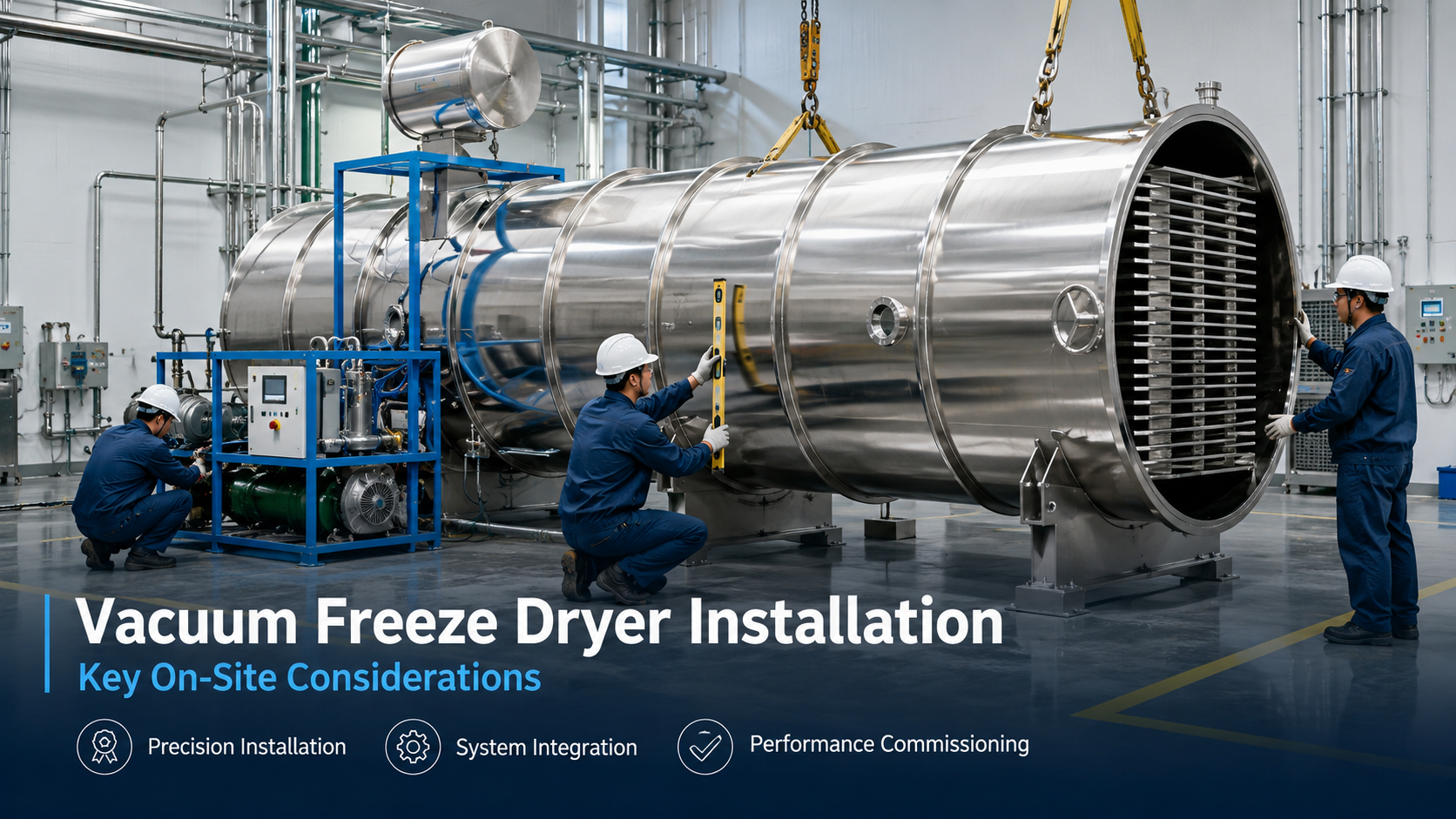
1. Select a Suitable Installation Location
The vacuum freeze dryer should be installed in a clean, dry, and well-ventilated area without direct sunlight, excessive dust, or moisture contamination.
Extremely high or low ambient temperatures may affect the refrigeration system, vacuum performance, energy consumption, and overall equipment stability. Therefore, the installation area should maintain a suitable and relatively stable temperature.
Enough space should also be reserved around the machine for ventilation, operation, cleaning, inspection, and maintenance.
2. Prepare the Necessary Installation Tools
Before installation begins, the required lifting, positioning, and assembly tools should be prepared.
Depending on the equipment size and configuration, these may include:
- · A crane or forklift
- · Lifting slings and supports
- · Torque wrenches
- · Screwdrivers and other hand tools
- · Wooden blocks or protective pads
- · A spirit level
- · Suitable lubricants
- · Electrical and pipeline installation tools
Using appropriate tools helps prevent equipment damage and ensures that positioning, leveling, assembly, and adjustment are completed correctly.
Large freeze dryers should be lifted and moved only by trained personnel using suitable lifting equipment.
3. Prepare a Strong and Level Foundation
Before installing the vacuum freeze dryer, the installation foundation must be completed and inspected.
The floor or equipment base should be clean, flat, strong, and capable of supporting the full operating weight of the machine. The total load should include not only the equipment itself, but also the product, trays, refrigeration system, vacuum system, and any supporting components.
Foundation strength, stability, and levelness can directly affect equipment vibration, mechanical alignment, door sealing, pipeline stress, and operating reliability.
For large industrial freeze dryers, the foundation should be constructed according to the equipment layout drawing and installation requirements provided by the manufacturer.
4. Lift, Position, Level, and Secure the Equipment
During installation, the equipment must be lifted, positioned, leveled, and secured carefully.
The specified lifting points should be used to avoid damaging the chamber, refrigeration pipes, electrical cabinet, vacuum components, or frame structure.
After positioning, use a spirit level to check the equipment in different directions. Adjust the supporting feet, pads, or foundation bolts until the machine is properly leveled.
The equipment should then be fixed securely to prevent movement, tilting, or vibration during operation. All fasteners should be tightened according to the recommended torque requirements.
5. Connect Pipelines and Arrange Electrical Cables Properly
Pipeline connection and cable arrangement are critical parts of vacuum freeze dryer installation.
Depending on the system configuration, installation may involve:
- · Vacuum pipelines
- · Cooling water inlet and outlet pipes
- · Drainage pipes
- · Compressed air or gas connections
- · Refrigeration-related connections
- · Power cables
- · Control and communication cables
All pipelines should be installed according to the equipment drawings. Vacuum connections must be clean, properly sealed, and free from unnecessary bends or mechanical stress.
Drainage pipes should have a suitable slope to prevent water accumulation. Cooling water flow, pressure, temperature, and water quality should meet the machine requirements.
Electrical cables should be arranged neatly and separated from hot surfaces, moving parts, and water sources. Electrical installation, grounding, and protection devices must comply with local safety regulations and should be completed by qualified technicians.
6. Check the Supporting Utilities
Before commissioning, confirm that all required utilities meet the equipment specifications.
Important checks may include:
- · Power supply voltage, frequency, and phase
- · Electrical load capacity
- · Grounding reliability
- · Cooling water flow and temperature
- · Drainage capacity
- · Room ventilation
- · Compressed air or process gas supply, where required
- · Exhaust conditions for the vacuum pump
- · Available maintenance space
An unstable power supply or insufficient cooling water can prevent the freeze dryer from operating correctly and may damage important components.
7. Inspect the Vacuum and Refrigeration Systems
Before startup, inspect all vacuum pipelines, valves, clamps, seals, hoses, and chamber connections.
Make sure that sealing surfaces are clean and that the chamber door gasket is correctly installed. Loose connections or damaged seals may cause air leakage and prevent the machine from reaching the required vacuum level.
The refrigeration system should also be inspected for transportation damage, loose components, abnormal oil marks, and pipeline deformation.
Refrigeration work involving refrigerant charging or sealed system repair should only be performed by qualified technicians.
8. Commission and Start the Equipment
After installation is completed, the vacuum freeze dryer should undergo systematic commissioning before production begins.
The commissioning process may include checking:
- · Power supply and electrical protection
- · Control system and alarms
- · Shelf cooling and heating performance
- · Cold trap temperature
- · Vacuum level and leakage rate
- · Cooling water flow
- · Drainage function
- · Compressor and vacuum pump operation
- · Temperature sensors and vacuum gauges
- · Emergency stop and safety protection devices
The equipment should first be tested without product. After confirming stable performance, a trial freeze drying cycle can be carried out using water or a representative material.
If any abnormal temperature, noise, vibration, pressure, or vacuum condition is detected, the machine should be stopped and inspected before production continues.
Conclusion
On-site installation of a vacuum freeze dryer should follow the manufacturer’s drawings, installation standards, and operating procedures. Every step—from site selection and foundation preparation to pipeline connection, electrical installation, leveling, and commissioning—should be completed carefully.
Correct installation can reduce operating risks, improve drying stability, and extend equipment service life.
BOTH provides vacuum freeze dryers from laboratory to industrial scale, together with installation guidance, commissioning, operator training, and customized production line support. What is your current production scale, are you planning to expand, and what capacity do you need? Talk to our engineers for a customized solution.
Media Contact
Company Name: BOTH Instrument & Industrial Equipment (Shanghai) Co., Ltd.
Email: Send Email
Country: China
Website: https://www.bothsh.com/


