
Core Riddle Proposes a New K-Philosophy for the Age of AGI and Robotics on July 4-America’s 250th Independence Anniversary
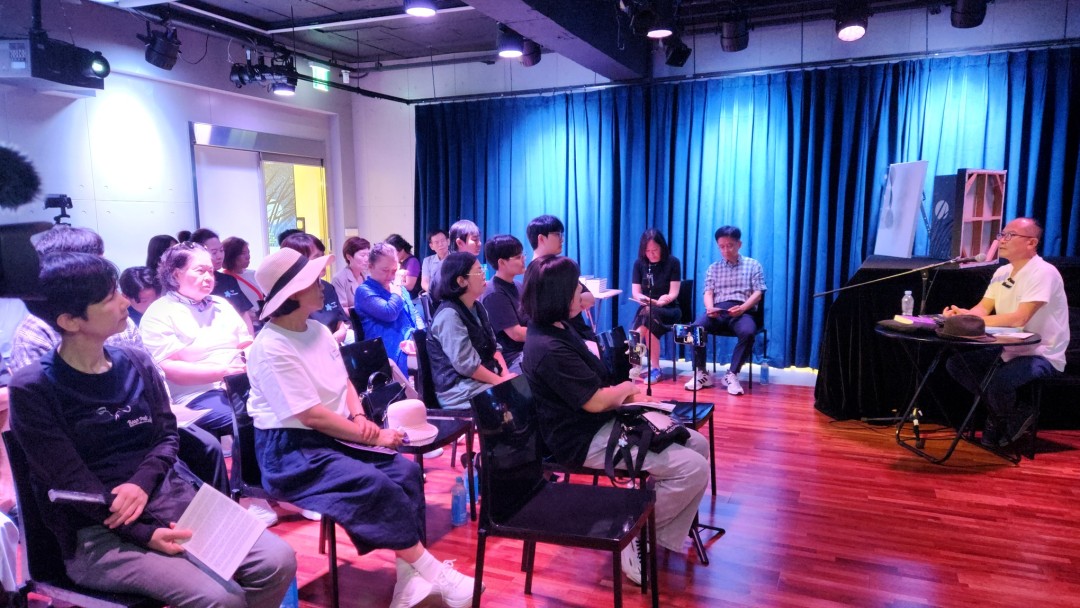
SEOUL, South Korea – On July 4, global attention was drawn to strikingly contrasting visions of civilization. Across the United States, large-scale celebrations and fireworks marked the 250th anniversary of American independence. At roughly the same time, Iran held the funeral of Supreme Leader Ayatollah Ali Khamenei alongside mass gatherings expressing resistance toward the United States. While these contrasting historical and political scenes unfolded around the world, another event carrying a different message took place in South Korea.
More than a conventional book launch, the gathering served as a reflection on both the achievements and limitations of the approximately 250 years of modern civilization shaped by capitalism and scientific advancement since the Industrial Revolution. Participants also examined the civilizational challenges and social consequences arising from accelerating technological innovation. Author and artist Core Riddle interpreted America’s 250th anniversary not merely as a national commemoration, but as a symbolic milestone marking a broader turning point for industrial civilization itself.
At the event, Core Riddle presented Pung-Ryu Philosophy as a new K-Philosophy capable of helping guide the future direction of civilization. K-Philosophy refers to philosophical ideas and intellectual traditions emerging from Korea, much as K-pop and K-drama have become global cultural phenomena. Held in celebration of the publication of his books The Humanities of a Painter and Artificial Intelligence and Future Humanities, the event explored a future in which Artificial General Intelligence (AGI), robotics, quantum computing, and fusion energy are rapidly moving from imagination toward reality.
Core Riddle argued that humanity must move beyond the twin extremes of technological worship and technological fear, and instead recover a new civilizational sensibility rooted in the spirit of Pung-Ryu. To address this challenge, he introduced Technetropy, a philosophical framework combining the ancient Greek concept of Techne—encompassing both art and technology—with Negentropy, the principle of life-generating order. He also proposed a new definition of the human being: Homo Meritus, meaning “the human who seeks fulfillment, meaning, and contribution.”
“Two hundred and fifty years is a recurring cycle in which empires rise and fall and ideologies undergo transformation,” Core Riddle said. “The concept of the ‘Big Cycle,’ explored by figures such as historian John Glubb and investor Ray Dalio, reflects this pattern. At this historical moment, I wanted to propose Pung-Ryu Philosophy as a new K-Philosophy capable of guiding the next stage of civilization and to introduce the practical concepts associated with it.”
These civilizational ideas have already attracted significant attention from international media. Articles discussing Pung-Ryu Philosophy and Technetropy have reportedly been distributed through more than 700 media outlets worldwide, including major international news organizations. Coverage distributed through The Associated Press (AP) helped introduce these concepts to audiences across multiple countries.
“Technetropy is not about accelerating technological development for its own sake,” he explained. “It is a framework that seeks technological progress aligned with negentropic and environmentally constructive directions. Likewise, Homo Meritus is an anthropological proposition that seeks to redefine the essence of human existence in an era when AI and robotics may replace much of human labor.”
The concept of ‘Homo Meritus’ was originally introduced by Romanian legal philosopher Anton P. Parlagi in his 2016 work Filosofia meritului, where it described the formation of human identity through educational and philosophical development. Core Riddle reinterprets the term as an ontological framework for understanding human existence in the age of AGI.
The author notes that definitions of humanity have always evolved with the times. In the eighteenth century, Carl Linnaeus introduced Homo sapiens to distinguish humans from other primates. During the Industrial Age, French philosopher Henri Bergson described humanity as Homo faber—the maker of tools. Later, Dutch historian Johan Huizinga characterized human beings as Homo ludens, “the playing human,” in his influential 1938 work. Modern society subsequently evolved around television, the internet, gaming, and digital media, integrating play deeply into everyday life.
“In an age when AI can think and create, human uniqueness can no longer be defined by labor or intellect,” Core Riddle explained. “Even the realm of play is increasingly shared with AI and robots. Therefore, in the age of self-aware AI Sapiens and Robo Faber, we must define humanity through the enduring emotions that machines cannot replicate: pride, fulfillment, dignity, and a sense of contribution.
Core Riddle also pointed out that the word ‘merit’ shares etymological roots with ‘mercy,’ criticizing how the modern term meritocracy has narrowed the broader historical meanings once associated with merit.
“Tracing the deeper roots of the term reveals associations with gifts received without qualification, as well as gratitude arising from mercy, grace, and unearned blessings,” the author noted. “In the age of AI and robotics, human value will lie in the sense of fulfillment (Boram in Korean) found in giving unconditional gifts that transcend transactional contracts, and in our deep capacity to feel gratitude for those gifts.” According to his philosophy, Homo Meritus represents a vision of humanity that seeks fulfillment not merely through work or entertainment, but through meaningful contribution to life, community, and the common good.
As humanity enters a period shaped simultaneously by the 250th anniversary of the modern industrial era and the emergence of superintelligent technologies, the proposal of Homo Meritus raises a fundamental question: “Will the next civilization continue pursuing technological acceleration alone, or will it move toward a new era grounded in coexistence, gratitude, and unconditional giving?”
Whether the concepts introduced by Core Riddle can serve as a new compass during an age of profound technological transformation remains to be seen. Yet supporters believe that Pung-Ryu Philosophy, proposed as a new K-Philosophy, may broaden the intellectual horizons of the Korean Wave (Hallyu) and contribute to a new worldview for the future of global civilization.
Media Contact
Company Name: Changbal
Contact Person: Core Riddle
Email: Send Email
Country: South Korea
Website: https://galleryinterstellar.com


