
Electroplating Explained: Principle, Materials, and Applications
Electroplating Explained: Principle, Materials, and Applications
From door handles and circuit connectors to automotive decorative trim and wearable jewellery, almost all metal items we interact with daily undergo an electroplating process. A microscopic thin metal coating is applied to these products to boost their aesthetic appearance, structural durability and corrosion resistance against harsh outdoor and indoor environmental factors.
Though this ultra-thin surface treatment is completely invisible to the naked eye, it plays an indispensable role in defining the service life and overall operational performance of metal components after they are manufactured and shipped out of factories. This article will offer a comprehensive breakdown covering fundamental chemical principles behind electroplating, as well as practical pros and cons that buyers need to consider carefully before confirming bulk procurement orders.
What Is Electroplating?
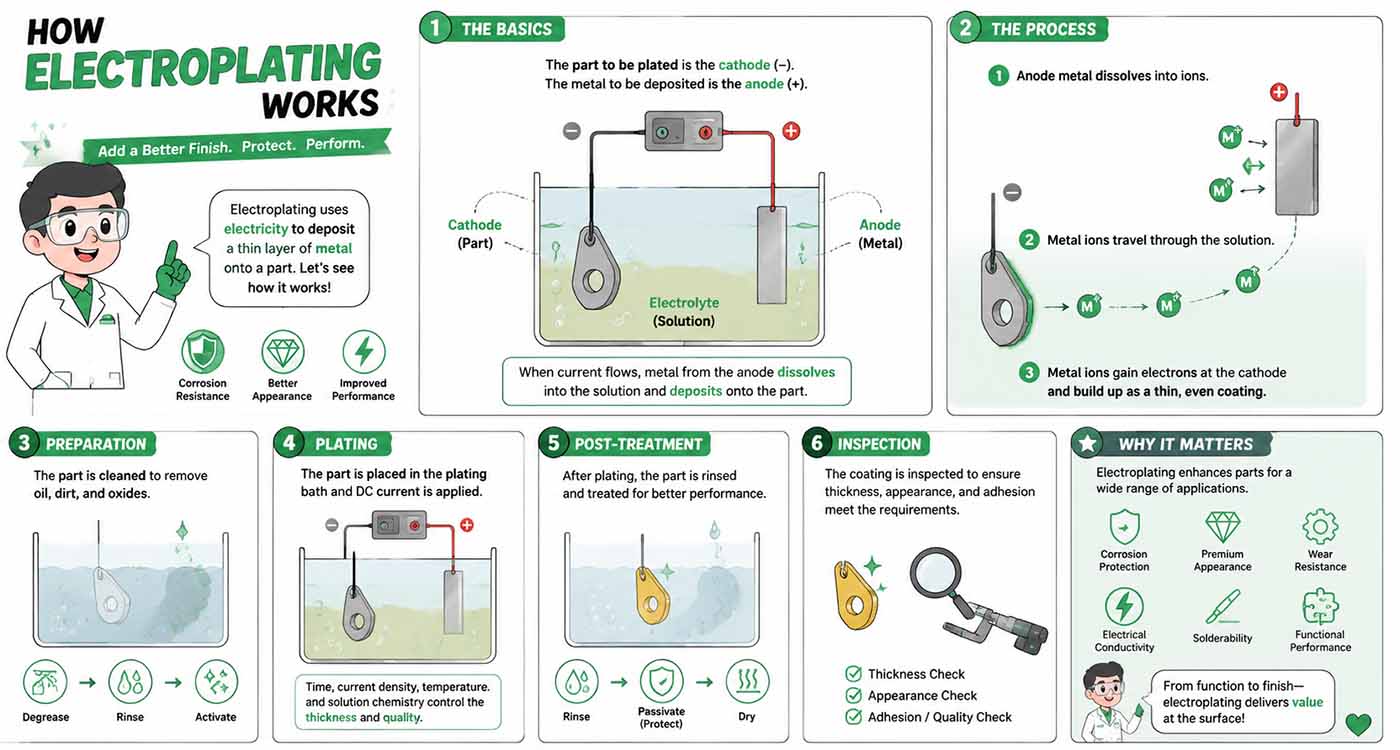
(AI generated)Schematic Diagram of the Electropolishing Process
Electroplating process uses electrical current to coat base materials with a thin metal film. Invented in the early 1800s, this surface finishing method has seen continuous upgrades, as introduced in the Wikipedia’s electroplating overview.
It bonds metals via electrochemical reactions instead of mechanical attachment, creating remarkably firm coatings. Widely used for decoration and functionality, for example, gold-plated decorative items and hard-chrome plated hydraulic shafts.
How Does the Electroplating Process Work?
At its core, electroplating runs on the principle of electrolysis. Four elements make the reaction possible: a power source, an anode, a cathode, and an electrolyte. Once current flows, metal ions in solution migrate toward the negatively charged workpiece and bond to its surface, building a uniform layer over time.
The Four Core Components
-
Power Source / Rectifier — converts AC current into the DC current the bath requires
-
Anode — usually the same metal being deposited; supplies ions as it oxidizes
-
Cathode — the workpiece itself, carrying a negative charge
-
Electrolyte — the ionic solution that carries metal ions toward the cathode
You can think of the bath as a closed loop: as ions leave the anode and settle on the cathode, the anode continually replenishes the solution, so the reaction sustains itself as long as current is supplied. Adjusting voltage, time, and ion concentration lets engineers fine-tune thickness, hardness, and appearance without changing the underlying chemistry.
Types of Electroplating Methods
Not every part suits the same setup. The right method depends on size, geometry, production volume, and the required finish quality.
| Method | Best For | Trade-off |
|---|---|---|
| Barrel Plating | Small, robust parts (screws, bolts) in high volume | Lower cost, but minor tumbling marks possible |
| Rack Plating | Large or delicate parts needing precise coverage | Higher quality, higher labor cost |
| Brush Plating | Localized repair or selective coating | Portable, but unsuited to large surfaces |
| Continuous (Reel-to-Reel) Plating | Long stock such as wire, strip, or tube | Efficient for length, less suited to complex shapes |
Barrel and rack plating remain the two most widely used approaches across industrial supply chains, while brush and continuous plating fill more specialized niches.
Common Metals Used in Electroplating Finishes
The choice of metal decides what the electroplating finishes actually deliver. Different metals exhibit varying appearances, electrical conductivity, hardness, and corrosion resistance after electroplating.
| Metal | Benefit | Typical Use |
|---|---|---|
| Zinc | Sacrificial corrosion protection, low cost | Screws, springs, brake pipes |
| Nickel | Corrosion and wear resistance, good base layer | Industrial components, decorative finishes |
| Copper | High conductivity, strong adhesion base | PCBs, electronic parts |
| Gold | Superior conductivity, luxurious appearance | Connectors, jewelry, PCB contacts |
| Silver | High conductivity, low friction | Solar panels, semiconductors |
| Chrome | Hardness, wear resistance, bright finish | Automotive and aerospace parts |
| Palladium | Cost-effective gold alternative, wear-resistant | Electronic connectors, medical parts |
If your project mixes requirements such as conductivity plus a premium look, combining a nickel base layer with a gold or silver top coat is common practice since not every metal bonds well directly with every substrate. Together, these options cover most of the standard electroplating finishes manufacturers specify today.
Why Manufacturers Choose Electroplated ComponentsPerformance Benefits
-
Significantly improves corrosion resistance in chemical or coastal environments.
-
Improved electrical conductivity for connectors and circuit parts
-
Increased surface hardness and wear resistance
-
Dimensional correction through controlled buildup thickness
-
Aesthetic upgrade without switching base materials
These advantages explain why electroplated components show up across aerospace, automotive, electronics, and jewelry manufacturing. A nickel-coated titanium turbine blade and a gold-plated connector pin solve very different problems, but both rely on the same underlying electrochemistry.
Limitations to Weigh
Electroplating can only process conductive base materials unless a pre-conductive coating is added beforehand. Besides, its protection effect merely acts on the material surface. Once the electroplated coating gets scratched or broken, the raw substrate underneath will be directly exposed.
Additionally, expensive initial setup fees and strict chemical management requirements further raise overall manufacturing costs. For this reason, manufacturers and buyers ought to fully evaluate these drawbacks before choosing electroplating as the final surface treatment solution.
Industrial Applications
Electroplating shows up wherever durability, conductivity, or appearance matters for electroplated components across these industries:
-
Aerospace: nickel or platinum coatings on turbine blades and fasteners for thermal and wear resistance
-
Automotive: chrome and zinc-nickel finishes on trim, fuel injectors, and battery contacts
-
Electronics: gold, copper, and palladium plating on connectors, PCBs, and semiconductors
-
Jewelry: gold, silver, and rhodium plating for appearance and longevity
Choosing the Right Partner for Your Project
Selecting a provider matters as much as choosing the metal. Look for established process equipment, documented quality control (Ra value, thickness, adhesion testing), relevant industry experience, and responsive technical support — a mismatch in any of these areas can turn a good design into a costly rework.
LVMA CNC typically machines parts to extremely high precision before they enter the plating bath; this is key to achieving superior plating results.
Conclusion
Electroplating remains one of the most dependable ways to upgrade a part’s surface without redesigning the part itself. Whether the goal is corrosion resistance, conductivity, hardness, or simple visual appeal, the right combination of method and metal can meet it. Understanding the electroplating process, the realistic material options, and where the technique’s limits lie puts you in a stronger position to specify a finish that actually matches your application — rather than guessing and hoping it holds up.
If your project calls for machined components ready for plating, LVMA CNC team can quote the machining work and help coordinate the surface-finishing specification, so the final part meets both its dimensional tolerances and its plating requirements from the start.
Media Contact
Company Name: Zhejiang LVMA Co., Ltd.
Email: Send Email
Country: China
Website: https://www.lvma-cnc.com/


