
Indonesia Cold Chain Logistics Market to Reach USD 9.24 Billion by 2031, as Pharma Distribution, Seafood Exports and Cold Storage Expansion Support Growth
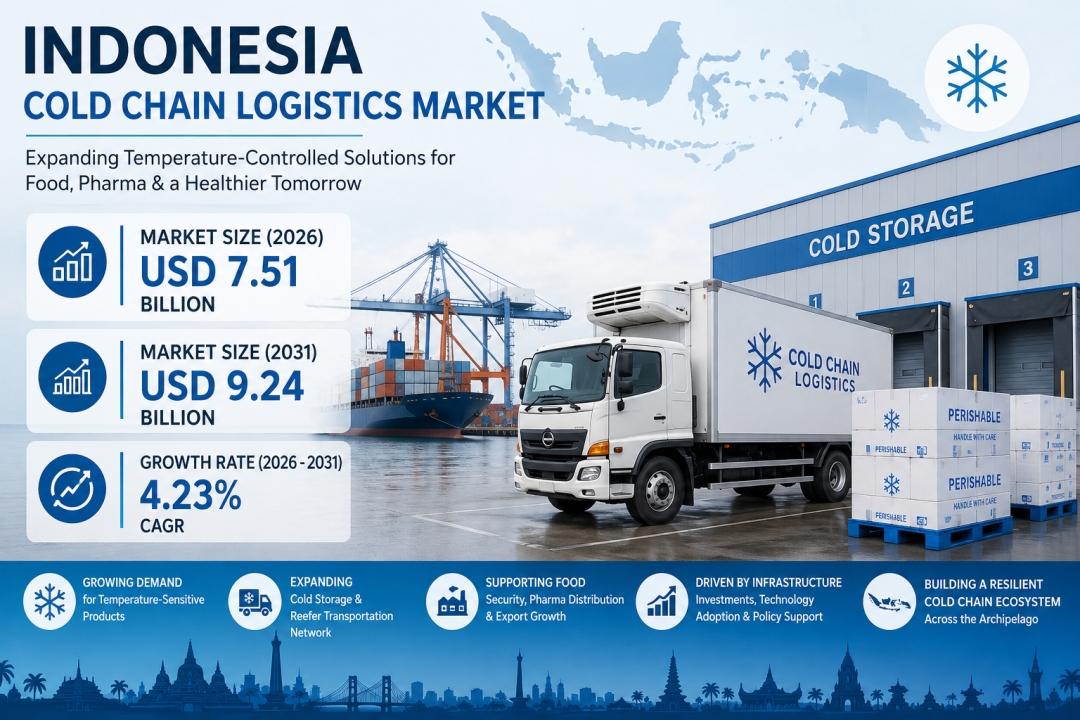
Hyderabad, India, September 05, 2026: According to Mordor Intelligence, the Indonesia Cold Chain Logistics Market is expected to grow from USD 7.19 billion in 2025 to USD 7.51 billion in 2026 and is forecast to reach USD 9.24 billion by 2031, registering a 4.23% CAGR during 2026–2031. The market is supported by increasing demand for temperature-controlled food distribution, expanding pharmaceutical logistics, seafood exports, modern retail, and investments in cold storage and port infrastructure.
Indonesia’s large archipelago creates a strong need for dependable refrigerated storage and transportation networks that can connect production areas, ports, processing facilities, retailers, healthcare providers, and consumers. Seafood remains an important source of cold-chain demand, while pharmaceutical and biologics distribution is creating additional requirements for certified facilities and controlled temperature handling. Online grocery and fresh-food delivery are also encouraging logistics providers to strengthen urban fulfillment and last-mile capabilities.
The Indonesia Cold Chain Logistics Market Size is influenced by both food and healthcare supply chains. At the same time, infrastructure gaps across outer islands, electricity costs, workforce availability, and the capital required for refrigerated assets remain challenges for operators seeking wider geographic coverage.
Indonesia Cold Chain Logistics Market Growth Drivers
Pharmaceutical Distribution Supports Specialized Cold-Chain Demand
Pharmaceuticals, vaccines, biologics, and other temperature-sensitive healthcare products are becoming an increasingly important part of Indonesia’s cold-chain network. Certified facilities, controlled-temperature storage, monitoring systems, and documented handling procedures are supporting more reliable pharmaceutical distribution.
Healthcare logistics providers are strengthening their capabilities around major distribution centers, while Jakarta continues to serve as an important logistics location. Public health supply-chain digitalization is also improving inventory visibility and distribution coordination. These developments are creating opportunities for logistics companies capable of meeting strict handling and compliance requirements.
Seafood Exports Strengthen Refrigerated Logistics Demand
Fish and seafood remain central to the Indonesia Cold Chain Logistics Industry, supported by domestic production and international demand. Export-oriented supply chains require continuous temperature control from harvesting and processing through storage, port handling, and international transportation.
Improved seafood traceability and compliance with international standards are encouraging operators to strengthen cold storage, reefer transportation, and handling capabilities. Growth in aquaculture is also increasing the need for cold facilities closer to production areas, helping reduce transit times and preserve product quality.
Online Grocery and Fresh Food Delivery Expand Urban Networks
The growth of online grocery and fresh-food delivery is increasing demand for refrigerated fulfillment, neighborhood distribution points, and temperature-controlled last-mile transportation. Consumers increasingly expect fresh and frozen products to arrive within short delivery windows, requiring logistics providers to coordinate storage and transportation more efficiently.
Modern retailers, convenience chains, and food delivery platforms are therefore creating opportunities for operators that can provide integrated warehousing, transportation, and visibility services. Shared cold-storage capacity and flexible logistics models can also help businesses expand into new urban markets without building complete infrastructure themselves.
Government and Infrastructure Investment Improve Cold-Chain Connectivity
Government initiatives aimed at strengthening logistics infrastructure are supporting the development of cold storage hubs and port facilities. Upgrades at key gateways can improve reefer-container handling, while investments in fishing ports can reduce post-harvest losses and strengthen connections between production centers and export markets.
However, the country’s geography continues to create differences in cold-chain availability between major islands and more remote locations. Uneven infrastructure and power reliability can increase operating costs and make temperature control more difficult outside established logistics corridors.
Check out more details and stay updated with the latest industry trends, including the Japanese version for localized insights: https://www.mordorintelligence.com/ja/industry-reports/indonesia-cold-chain-logistics-market?utm_source=abnewswire
Indonesia Cold Chain Logistics Market Segmentation
The Indonesia Cold Chain Logistics Market is segmented by service type, temperature type, application, and geography. The market includes a broad range of food, healthcare, and other temperature-sensitive products.
-
By Service Type: Refrigerated Storage, Refrigerated Transportation, and Value-Added Services. Refrigerated storage includes public and private warehousing, while transportation covers road, rail, sea, and air. Value-added services include activities such as labeling, portioning, blast freezing, and temperature-related validation.
-
By Temperature Type: Chilled, Frozen, Ambient, and Deep-Frozen/Ultra-Low. Frozen logistics remains closely linked to seafood and frozen-food distribution, while ambient temperature-controlled services are gaining relevance in pharmaceutical logistics and other applications requiring stable conditions.
-
By Application: Fruits and Vegetables, Meat and Poultry, Fish and Seafood, Dairy and Frozen Desserts, Bakery and Confectionery, Ready-to-Eat Meals, Pharmaceuticals and Biologics, Vaccines and Clinical Trial Materials, Chemicals and Specialty Materials, and Other Perishables.
-
By Geography: Java, Sumatra, Kalimantan, Sulawesi, Bali and Nusa Tenggara, and Others. Java remains the main center of activity because of its concentration of distribution networks, retailers, pharmaceutical supply chains, and logistics facilities. Sulawesi is expected to see strong growth as seafood activity and logistics infrastructure develop further.
Explore Our Full Library of Logistics Research Reports: https://www.mordorintelligence.com/market-analysis/logistics?utm_source=abnewswire
Indonesia Cold Chain Logistics Market Major Players
The competitive environment remains fragmented, with domestic and international logistics providers serving different regions and product categories. Competition is based on network coverage, pricing, storage capacity, transportation capabilities, compliance, and the ability to provide reliable temperature control.
Major companies identified in the market include Kiat Ananda Group, Enseval Putera Megatrading Tbk, MGM Bosco Logistics, Samudera Logistics, and Pluit Cold Storage. These companies participate across areas such as refrigerated warehousing, transportation, distribution, and specialized cold-chain services.
Operators are also strengthening network coverage and service capabilities to address demand from modern retail, seafood exporters, pharmaceutical distributors, food processors, and online grocery businesses. Companies with established infrastructure and the ability to coordinate multiple temperature-controlled activities are positioned to serve customers seeking more integrated logistics solutions.
Indonesia Cold Chain Logistics Market Forecast
The Indonesia Cold Chain Logistics Market Forecast points to steady expansion as temperature-sensitive supply chains become increasingly important across food, healthcare, retail, and export activities. Seafood exports, pharmaceutical distribution, online grocery, and government-backed infrastructure development are expected to remain important sources of demand.
Future market opportunities will depend on improving connectivity between major logistics hubs and secondary regions, expanding reliable cold storage, strengthening refrigerated transportation, and addressing power and operating-cost challenges. Greater use of traceability and coordinated logistics services should also support higher service standards.
Overall, the Indonesia Cold Chain Logistics Market Trends indicate a market moving toward broader geographic coverage and more specialized services. As businesses seek dependable temperature-controlled logistics for domestic and international supply chains, cold-chain providers with strong infrastructure, compliance capabilities, and reliable distribution networks are expected to remain well positioned through the forecast period.
For more insights on the Indonesia Cold Chain Logistics Market, please visit the Mordor Intelligence page: https://www.mordorintelligence.com/industry-reports/indonesia-cold-chain-logistics-market?utm_source=abnewswire
Industry Related Reports:
Asia-Pacific Cold Chain Logistics Market Size: The Asia-Pacific cold chain logistics market is projected to reach USD 224.25 billion by 2031, supported by expanding biopharmaceutical production, digital trade systems, and supermarket-led distribution networks. These developments are shifting infrastructure priorities toward automated, energy-efficient, and sustainability-compliant cold storage and logistics facilities.
Get more insights: https://www.mordorintelligence.com/industry-reports/asia-pacific-cold-chain-logistics-market?utm_source=abnewswire
Africa Cold Chain Logistics Market Size: The Africa Cold Chain Logistics Market is projected to reach USD 18.29 billion by 2031, supported by rising urbanization, expanding local vaccine manufacturing, and growing regional trade under the African Continental Free Trade Area (AfCFTA). These developments are increasing the need for reliable temperature-controlled infrastructure across food, healthcare, and pharmaceutical supply chains.
Get more insights: https://www.mordorintelligence.com/industry-reports/africa-cold-chain-logistics-market?utm_source=abnewswire
About Mordor Intelligence:
Mordor Intelligence is a trusted partner for businesses seeking comprehensive and actionable market intelligence. Our global reach, expert team, and tailored solutions empower organizations and individuals to make informed decisions, navigate complex markets, and achieve their strategic goals.
With a team of over 550 domain experts and on-ground specialists spanning 150+ countries, Mordor Intelligence possesses a unique understanding of the global business landscape. This expertise translates into comprehensive syndicated and custom research reports covering a wide spectrum of industries, including aerospace & defense, agriculture, animal nutrition and wellness, automation, automotive, chemicals & materials, consumer goods & services, electronics, energy & power, financial services, food & beverages, healthcare, hospitality & tourism, information & communications technology, investment opportunities, and logistics.
For any inquiries or to access the full report, please contact:
https://www.mordorintelligence.com/
Media Contact
Company Name: Mordor Intelligence
Contact Person: Jignesh Thakkar
Email: Send Email
Phone: +1 617-765-2493
Address:11th Floor, Rajapushpa Summit, Nanakramguda Rd, Financial District, Gachibowli [email protected]
City: Hyderabad
State: Telangana 500008
Country: India
Website: https://www.mordorintelligence.com/


