
Congenital Hyperinsulinism Market Size in the 7MM is projected to grow at a significant CAGR over the forecast period of 2026-2036 | DelveInsight
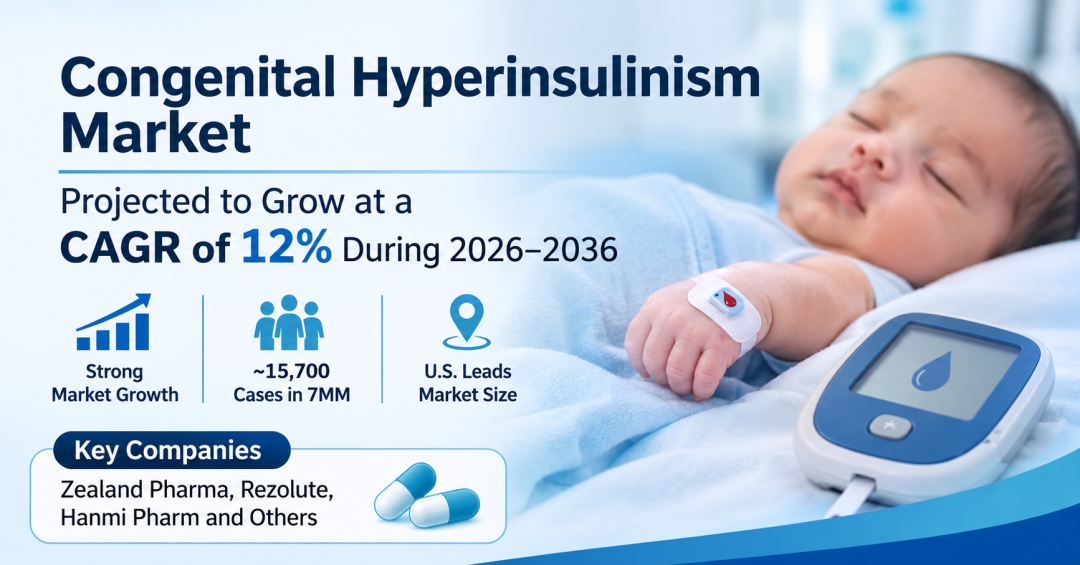
(Albany, US), November 06, 2026 – DelveInsight’s ‘Congenital Hyperinsulinism Market Insights, Epidemiology and Market Forecast – 2036’ report delivers an in-depth understanding of congenital hyperinsulinism, historical and forecasted epidemiology, as well as the congenital hyperinsulinism market trends in the United States, EU4 (Germany, Spain, Italy, and France), the United Kingdom, and Japan.
Explore the intricate details of the Congenital Hyperinsulinism Market Report @ Congenital Hyperinsulinism Treatment Market Size
Key Takeaways from the Congenital Hyperinsulinism Market Report
-
In August 2026, Rezolute continued advancing ersodetug (RZ358) for congenital hyperinsulinism, with plans to engage with the FDA regarding the regulatory pathway following the Phase III sunRIZE study. The company identified FDA discussions in the second half of 2026 as the next key milestone for its congenital HI program.
-
In August 2026, Rhythm Pharmaceuticals continued progressing its preclinical programs for congenital hyperinsulinism as part of its broader rare neuroendocrine disease development pipeline.
-
According to DelveInsight’s analysis, the congenital hyperinsulinism treatment market size in the 7MM was approximately USD 110 million in 2025 and is expected to rise during the forecast period (2026–2036).
-
The congenital hyperinsulinism market is projected to grow at a CAGR of 12% during 2026–2036.
-
The United States is expected to account for the largest congenital hyperinsulinism market size, at approximately USD 45 million in 2025.
-
Congenital hyperinsulinism prevalence in the 7MM stood at approximately 15,700 diagnosed prevalent cases in 2025, and this number is expected to increase during the forecast period.
-
Within the EU4 and the UK, Germany accounted for the highest number of cases in 2025, with approximately 2,800 cases reported.
-
The emerging congenital hyperinsulinism CHI drug pipeline analysis highlights targeted, mechanism-driven candidates such as Ersodetug (RZ358), ZEGALOGUE, and Efpegerglucagon.
-
The leading Congenital Hyperinsulinism Companies include Zealand Pharma, Rezolute, Hanmi Pharm, and others.
-
Promising Congenital Hyperinsulinism Therapies include ZEGALOGUE, Ersodetug (RZ358), Efpegerglucagon, and others.
Get a Free sample for the Congenital Hyperinsulinism Market Forecast, Size & Share Analysis Report @ Congenital Hyperinsulinism Therapeutics Market
Congenital Hyperinsulinism Overview
Congenital hyperinsulinism is a rare, inherited metabolic disorder characterized by inappropriate and excessive secretion of insulin from pancreatic β-cells, leading to persistent hypoglycemia, particularly in neonates and infants. It arises from genetic mutations affecting key regulators of insulin secretion, most commonly in genes encoding components of the pancreatic K_ATP channel, such as ABCC8 and KCNJ11. Unrestrained insulin secretion inhibits hepatic glucose production and ketogenesis, depriving the brain of essential energy substrates and increasing the risk of seizures, developmental delay, and permanent neurological damage if not promptly managed. The disease presents in diffuse and focal forms with varying severity and responsiveness to therapy. Diagnosis relies on persistent hypoglycemia with elevated insulin, low blood ketones, and suppressed free fatty acids, confirmed through a critical sample test, genetic testing, and 18F-DOPA PET/CT imaging to differentiate focal from diffuse disease.
Congenital Hyperinsulinism Epidemiology Segmentation in the 7MM
-
Total Diagnosed Prevalent Cases of Congenital Hyperinsulinism
-
Type-specific Diagnosed Prevalent Cases of Congenital Hyperinsulinism based on Histological Presentation
-
Mutation-specific Diagnosed Prevalent Cases of Congenital Hyperinsulinism
-
Total Treated Cases of Congenital Hyperinsulinism
Download the report to understand which factors are driving Congenital Hyperinsulinism Epidemiology trends @ Congenital Hyperinsulinism Prevalence
Congenital Hyperinsulinism Epidemiology Key Findings
-
Congenital hyperinsulinism prevalence in the 7MM was approximately 15,700 diagnosed prevalent cases in 2025, which is expected to increase during 2026–2036.
-
The highest number of prevalent cases was observed in the United States, while Germany led the EU4 and the UK with approximately 2,800 cases in 2025.
-
In Japan, ABCC8 and KCNJ11 gene mutations have the highest contribution, followed by other gene mutations.
-
In 2025, France reported nearly 1,750 cases of diffuse congenital hyperinsulinism, 360 focal cases, and 165 atypical cases, a distribution that highlights the variability of the disorder. These numbers are anticipated to rise by 2036, emphasizing the need for improved diagnostics.
Approved Therapies for Congenital Hyperinsulinism
Congenital hyperinsulinism treatment options remain largely focused on symptomatic management and prevention of hypoglycemia, including frequent feeding, continuous glucose infusion, and pharmacological interventions. Diazoxide is the first-line therapy, and cost considerations such as proglycem cost can influence how patients access it. Somatostatin analogs such as octreotide and lanreotide are used in diazoxide-unresponsive cases. Octreotide is given subcutaneously or intravenously, while lanreotide is a long-acting monthly option, though these drugs may cause gastrointestinal issues, growth suppression, and gallstones. Glucagon is used in acute hypoglycemic episodes, and severe or refractory cases, particularly focal disease, may require partial pancreatectomy. Despite these options, treatment response remains highly variable, with a substantial proportion of patients showing resistance to standard therapies.
Congenital Hyperinsulinism CHI Drug Pipeline Analysis
-
ZEGALOGUE (Dasiglucagon): Zealand Pharma
ZEGALOGUE is a glucagon analog that increases blood glucose by stimulating hepatic glucose release. While approved for severe hypoglycemia in diabetes, it may have relevance in congenital hyperinsulinism due to its ability to counteract hypoglycemia associated with excessive insulin secretion. The drug is currently in the registration phase, and Zealand Pharma expects to resubmit a new drug application (NDA) in 2H 2026. In October 2024, the US FDA issued a second complete response letter (CRL) for ZEGALOGUE to treat hypoglycemia in congenital hyperinsulinism, requesting additional analyses from Phase III continuous glucose monitoring data.
-
Ersodetug (RZ358): Rezolute
Ersodetug is an investigational monoclonal antibody designed to regulate insulin activity by targeting the insulin receptor, thereby helping to stabilize blood glucose levels in congenital hyperinsulinism. It is a negative allosteric modulator of the insulin receptor (INSR), administered via IV infusion, and is currently in Phase III clinical development. The drug has received several regulatory designations, including the BTD, the UK’s Innovative Licensing and Access Pathway (ILAP), and Orphan Drug Designations (ODD) from the US and the European Union for congenital hyperinsulinism and insulinoma-related hypoglycemia. In December 2025, Rezolute reported that its Phase III sunRIZE study did not meet the primary endpoint of reducing weekly hypoglycemia events. In August 2026, the company indicated it expects to engage with the FDA on the regulatory path forward in the second half of 2026.
Discover more about therapies set to grab Major Congenital Hyperinsulinism Market Share @ Congenital Hyperinsulinism Market Drivers and Barriers
Congenital Hyperinsulinism Market Outlook
The congenital hyperinsulinism market is beginning to evolve with the emergence of targeted and mechanism-driven therapies. Investigational agents such as Ersodetug (RZ358) are designed to modulate insulin receptor signaling, offering a novel approach for patients with severe or treatment-resistant disease and representing a shift toward functional disease modification. Pharmaceutical companies and research institutions are actively advancing clinical development programs, reflecting growing interest in this rare disorder and in the broader hyperinsulinemic hypoglycemia market and hyperinsulinemia market. Ongoing research is focused on improving understanding of disease biology and identifying new therapeutic targets through genetic and molecular insights. Increasing competition among emerging therapies is likely to drive innovation and improve patient outcomes, and the congenital hyperinsulinism therapeutics market is expected to increase during the forecast period (2026–2036). As a rare genetic condition, it also forms part of the wider congenital anomalies treatment market.
Congenital Hyperinsulinism Market Drivers
-
Rising awareness and improved diagnosis, supported by genetic testing and neonatal screening
-
Advancements in genetic testing and precision diagnostics, including next-generation sequencing
-
Increasing detection of rare genetic disorders through patient registries and reporting systems
-
Growing clinical development activity and an expanding emerging pipeline
Congenital Hyperinsulinism Market Barriers
-
Absence of disease-modifying treatments
-
Limited targeted and precision therapies
-
Dependence on invasive surgical procedures
-
Risk of long-term neurological complications
-
Limited awareness and delayed diagnosis
Congenital Hyperinsulinism Treatment Landscape
The primary goal of congenital hyperinsulinism treatment is to maintain normal blood glucose levels to prevent complications and improve quality of life. Initial management includes frequent feeding and intravenous glucose, with diazoxide as first-line therapy and somatostatin analogs for unresponsive cases. Non-pharmacological management includes high-protein and complex carbohydrate diets, continuous enteral feeding for severe cases, and cornstarch therapy for older children. Targeted pancreatectomy can cure focal disease, while diffuse disease may necessitate near-total pancreatectomy, increasing diabetes risk. 18F-DOPA PET scans guide surgical decisions, and continuous glucose monitoring helps prevent severe hypoglycemia.
To know more about Congenital Hyperinsulinism Companies working in the treatment market, visit @ Congenital Hyperinsulinism Market Access and Reimbursement
Scope of the Congenital Hyperinsulinism Market Report
-
Coverage: 7MM (US; Germany, France, Italy, Spain, and the UK; Japan)
-
Study Period: 2022–2036
-
Historical Year: 2022–2025
-
Base Year: 2026
-
Forecast Period: 2026–2036
-
Congenital Hyperinsulinism Market CAGR: 12% (2026–2036)
-
Congenital Hyperinsulinism Companies: Zealand Pharma, Rezolute, Hanmi Pharm, and others
-
Congenital Hyperinsulinism Therapies: ZEGALOGUE, Ersodetug (RZ358), Efpegerglucagon, and others
-
Congenital Hyperinsulinism Market Dynamics: market drivers and barriers
-
Congenital Hyperinsulinism Competitive Intelligence Analysis: SWOT Analysis, Conjoint Analysis
-
Congenital Hyperinsulinism Unmet Needs, KOL Views, Reimbursement
Table of Content
-
Key Insights
-
Report Introduction
-
Executive Summary of Congenital Hyperinsulinism
-
Key Events
-
Epidemiology and Market Forecast Methodology
-
Congenital Hyperinsulinism Market Overview at a Glance
-
Disease Background and Overview of Congenital Hyperinsulinism
-
Treatment and Management of Congenital Hyperinsulinism
-
Treatment Guidelines
-
Epidemiology and Patient Population of Congenital Hyperinsulinism
-
Patient Journey of Congenital Hyperinsulinism
-
Emerging Drugs
-
Congenital Hyperinsulinism: 7MM Analysis
-
Unmet Needs of Congenital Hyperinsulinism
-
SWOT Analysis of Congenital Hyperinsulinism
-
KOL Views of Congenital Hyperinsulinism
-
Market Access and Reimbursement of Congenital Hyperinsulinism
-
Appendix
-
DelveInsight Capabilities
-
Disclaimer
-
About DelveInsight
Media Contact
Company Name: DelveInsight Business Research LLP
Contact Person: Abhishek kumar
Email: Send Email
Phone: +19193216187
Address:304 S. Jones Blvd #2432
City: Albany
State: New York
Country: United States
Website: https://www.delveinsight.com/report-store/congenital-hyperinsulinism-market


