
5 Powerful Image Dataset Sources for Training AI Models in 2026
At the end of the day, an AI model is only as good as the data behind it. More examples, greater variety, and higher-quality inputs lead to better, more reliable results. But without the right training dataset, even the best architecture will fall short.
In this article, we’ve rounded up five powerful sources for image datasets that are helping developers and researchers build smarter AI models in 2026. Whether you’re working on object detection, image classification, or facial recognition, you’ll find a dataset worth exploring.
What is an image dataset?
An image dataset is a structured collection of labeled images used to train, test, and evaluate computer vision models. By exposing AI to thousands or even millions of examples, these datasets help models learn to recognize patterns and identify objects, powering everything from facial recognition and object detection to image classification.
Common use cases for image datasets
- Reverse image search
Image datasets are the foundation of reverse image search, a feature that allows users to find similar or identical images by uploading a picture or providing a URL instead of typing text. It’s widely used by stock content platforms like DepositPhotos, e-commerce apps such as Vinted, and search engines like Google.
By training on large collections of labeled images, AI models learn to compare visual features and match an uploaded image with visually similar content across the web or within a platform. As a result, users can quickly identify a product in an image or find a higher-resolution version of a photo without typing a single word.
- Behavior analysis
Image datasets are also central to behavior analysis, where AI models are trained to detect and interpret human actions, facial expressions, and behavioral patterns. This can be used to monitor a driver’s attention on the road or measure student engagement in classrooms.
Even a small image dataset can be enough to get started, as long as you provide your model with quality data. That means the images need to be diverse, well-labeled, and representative of real-world conditions. Otherwise, the model may perform well during training but fall short in real-world applications.
- Medical image analysis
Medical image datasets are useful for the early detection of diseases, including tumors, fractures, and other abnormalities. By training AI models on thousands of labeled X-rays, MRIs, and CT scans, healthcare providers can develop systems that help identify these conditions more quickly and, in some cases, more accurately than traditional methods.
Beyond detection, medical image analysis can also help reduce the workload of healthcare professionals. Amplifai Health, for example, enables nurses to conduct AI-assisted screenings and generate clinical risk scores. This allows medical staff to prioritize high-risk cases, improving the overall efficiency of care.
- Facial recognition
Image datasets also power facial recognition systems, training AI models to identify and analyze facial features. Once trained, these models can match a face against a database to verify or identify a specific individual—even in crowded environments or poor lighting conditions.
Today, facial recognition is widely used by law enforcement, security services, and technological companies. With an accuracy rate of at least 99.5%, it helps identify suspects in surveillance footage, enables identity verification in offices, supports security screenings at airports, and powers features like facial authentication on smartphones.
5 Best image dataset sources to train your AI models
1. DepositPhotos
DepositPhotos is a common choice for businesses looking to train AI models on high-quality, licensed data. The platform provides access to over 310 million well-labeled images, videos, and audio files spanning a wide range of subjects and styles. This data is well-suited for generative AI, computer vision, and facial recognition tasks.
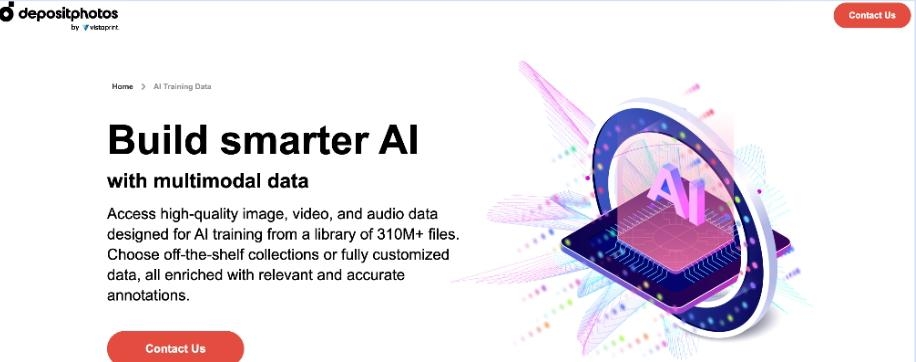
DepositPhotos offers several ways to access its content. You can browse ready-to-use collections for a quick start or work directly with their team to build a fully customized dataset tailored to your specific training requirements.
What sets DepositPhotos apart is its focus on licensing and legal compliance. All content on the platform is rights-cleared, meaning businesses can use it for AI training without worrying about copyright issues. However, DepositPhotos is a commercial platform, so access to its dataset isn’t free.
2. LAION
For those looking for free image datasets, LAION is worth considering. The project offers some of the largest openly available image-text datasets, including LAION-400M, LAION-5B, RE-LAION-5B, and LAION-Aesthetics—each tailored to different sizes, languages, and use cases.
The datasets were created by scraping image-text pairs from the internet, meaning the data was collected automatically rather than curated by hand. While this approach allows for massive scale, it comes with notable trade-offs.
Unlike licensed datasets like DepositPhotos, open datasets like LAION can contain quality inconsistencies, potential copyright violations, and even harmful or illegal content. This doesn’t make LAION a bad choice, but it does mean you should approach it cautiously.
3. ImageNet
ImageNet is one of the most widely used databases for computer vision datasets, containing over 14 million labeled images across more than 20,000 categories. It is commonly applied in image classification and object recognition tasks.
Although ImageNet is available for free, its use is limited to non-commercial, research, and educational purposes. This is because ImageNet does not own the copyright to the images themselves and instead provides links to publicly available sources, where copyright is held by the original creators.
For researchers, ImageNet remains one of the most valuable resources in computer vision. However, if you’re building a commercial AI product, you’ll need to look elsewhere. A licensed image dataset source like DepositPhotos is a safer and more practical choice for business use.
4. COCO
COCO, or Common Objects in Context, is another widely used AI image dataset containing 330,000 images across 80 object categories. Its detailed annotations make it well-suited for tasks such as object detection, segmentation, and image captioning.
The dataset is available for research and development use, including some commercial applications. However, the images are sourced from Flickr and retain their original licenses, so commercial use depends on the licensing terms of the individual images.
5. Open Images
Open Images is a large-scale dataset developed by Google, featuring 9 million images across more than 6,000 categories. It is commonly used to train computer vision models, especially for tasks like object detection, segmentation, and image classification.
Like COCO, the Open Images dataset is free for both research and commercial purposes. However, you should verify the specific license of individual images when using them commercially.
Final thoughts
Choosing the right image dataset source is one of the most important decisions you’ll make when building an AI model. It directly affects how well your model performs and how reliable it is in real-world scenarios. Whether you need a free option for research or a fully licensed dataset for commercial use, the five platforms on this list are a good place to start.
Media Contact
Company Name: depositphotos
Email: Send Email
Country: United States
Website: depositphotos.com


